Learn Gulf Arabic Online for Beginners: A Practical Guide to Khaleeji Arabic
Quick answers
What is Gulf Arabic? Gulf Arabic (Khaleeji) is a group of closely related spoken Arabic varieties used across the Arabian Peninsula. It is primarily a spoken form of Arabic rather than a written standard.
Where is Gulf Arabic spoken? Mainly in Saudi Arabia, the United Arab Emirates, Kuwait, Qatar, Bahrain, and Oman, with noticeable regional and country-level variation.
Is Gulf Arabic the same as Fusha? No. Fusha (Modern Standard Arabic) is the shared formal and written variety used in news, books, and official contexts. Gulf Arabic is used in everyday conversation. The two are related and overlap in vocabulary, but they are not interchangeable.
What is Khaleeji Arabic? Khaleeji (خليجي) means "of the Gulf" and is the common Arabic term for Gulf Arabic. "Khaliji" and "Khaleeji" are two spellings of the same word.
Can beginners learn Gulf Arabic? Yes. Many learners begin directly with a spoken variety, focusing first on listening, pronunciation, greetings, and high-frequency phrases before moving to longer sentences.
What is Gulf Arabic (Khaleeji)?
Gulf Arabic, known in Arabic as Khaleeji (خليجي), refers to the related spoken Arabic varieties of the Arabian Peninsula. The name comes from khaleej (خليج), meaning "Gulf" — the same word used in phrases such as Khaleeji music and Khaleeji cuisine.
It is important to be precise here: Gulf Arabic is not a single uniform dialect. It is a grouping of varieties that share a large amount of vocabulary, pronunciation features, and sentence structure, while still differing between countries, cities, and communities. Speakers from different Gulf countries generally communicate with each other without much difficulty, but that does not mean every variety is identical or that every speaker understands every regional form equally well.
Like other spoken Arabic varieties, Gulf Arabic is mainly used in speech. Writing — newspapers, official documents, signage, formal correspondence — is normally done in Modern Standard Arabic, although dialect is commonly written informally in messaging and on social media.

Gulf Arabic vs. Modern Standard Arabic (Fusha)
Arabic speakers typically use both a formal shared variety (Fusha) and a local spoken variety. The two serve different purposes rather than competing with each other.
| Fusha (Modern Standard Arabic) | Gulf Arabic (Khaleeji) | |
|---|---|---|
| Everyday spoken communication | Rarely used in casual conversation | The normal medium of daily speech in the Gulf |
| Formal / written communication | The standard for news, books, official documents, and formal speeches | Mostly spoken; written informally in messaging and social media |
| Typical learning goals | Reading, media comprehension, academic and religious texts, formal writing | Conversation, listening comprehension, daily interaction |
| Where learners use it | University courses, reading, formal settings across the Arab world | Workplaces, markets, homes, and social life in the Gulf region |
| Relationship between them | Provides much of the shared vocabulary and grammatical base | Draws on that base, with simplified grammar and local vocabulary and pronunciation |
Neither one replaces the other. Learners aiming at reading and formal comprehension generally start with Fusha; learners who want to hold everyday conversations in the Gulf usually get faster practical results by working on the spoken variety. Many learners eventually study both. If you want the longer comparison, see Fusha vs Gulf Arabic, and for the formal side see the Modern Standard Arabic learning page.
Where is Gulf Arabic spoken?
Gulf Arabic varieties are spoken mainly in six countries:
- Saudi Arabia — particularly in the central and eastern regions; the country as a whole contains several distinct dialect areas.
- United Arab Emirates
- Kuwait
- Qatar
- Bahrain
- Oman — Omani varieties are often described as the most distinct within the group.
Within each country there is further variation between regions, cities, rural and urban communities, and generations. The Gulf is also highly multilingual: English and South Asian languages are widely used in workplaces and service settings, and code-switching between Arabic and English is common in larger cities.
Gulf Arabic by country
The table below is a general orientation, not a strict classification. Dialect boundaries do not follow national borders neatly.
| Country | Varieties include | Notes |
|---|---|---|
| Saudi Arabia | Najdi (central), Hijazi (west), Gulf varieties of the Eastern Province | Hijazi differs noticeably from Najdi; the Eastern Province is closest to other Gulf varieties |
| United Arab Emirates | Emirati varieties across the emirates | Heavy day-to-day contact with English in Dubai and Abu Dhabi |
| Kuwait | Kuwaiti varieties | Widely heard through Kuwaiti television drama across the region |
| Qatar | Qatari varieties | Shares many features with Emirati and Najdi speech |
| Bahrain | Bahraini varieties, including distinct community-based forms | More than one long-established variety within a small area |
| Oman | Omani varieties | Historical contact with Swahili, Baluchi, and Persian; several regional forms |
Learning a widely shared core of Gulf vocabulary and pronunciation gives you a usable starting point across the region, and you then adjust to the local variety where you live.
Gulf Arabic for beginners: what should you learn first?
A practical order for beginners, useful with any course, tutor, or self-study method:
1. Pronunciation and listening
Start with the sounds before the script. Spend the first weeks listening to natural Gulf speech and imitating it aloud, paying attention to sounds that may be unfamiliar, such as ʿayn (ع), ḥāʾ (ح), and the local realisations of qāf (ق) and jīm (ج).
2. Greetings and introductions
Greetings carry a lot of social weight in the Gulf. Learn how to greet, respond, introduce yourself, and say where you are from — and expect regional preferences, for example shlonak? in much of the Gulf versus kayf ḥālak? elsewhere.
3. Common everyday phrases
Politeness formulas, thanks, apologies, and short service exchanges (shops, taxis, cafés, offices) cover a large share of daily interaction.
4. High-frequency vocabulary
Prioritise words you will actually use: numbers, time, food, transport, workplace terms, family, and directions. A few hundred well-chosen words go a long way in conversation. A ready-made starting list is available in 100 essential Gulf Arabic phrases.
5. Sentence patterns
Rather than memorising full grammar tables, learn reusable frames — "I want…", "Is there…?", "Can you…?", "I'm going to…" — and swap vocabulary into them.
6. Questions and responses
Learn the question words and the typical short answers. Being able to ask and understand simple questions turns passive study into real conversation.
7. Listening practice
Use Gulf media: interviews, dramas, podcasts, and everyday recordings. Repeated exposure to natural speed is what makes real conversations comprehensible.
8. Speaking practice
Speak early and often, even imperfectly — with a tutor, a language partner, colleagues, or by recording yourself. Output is where passive knowledge becomes usable.
9. Spaced repetition and review
Review vocabulary and phrases on a spaced schedule rather than in single long sessions. Short, regular study is generally more effective than occasional intensive study.

Why learn Gulf Arabic?
Reasons learners commonly give:
- Living in the Gulf. Everyday errands, neighbours, schools, and administration are easier when you can follow the spoken language.
- Work. Many workplaces operate in English, but internal conversations, site work, client relationships, and informal discussion often happen in Arabic.
- Travel. Even basic spoken Arabic changes the quality of interactions outside tourist areas.
- Social communication. Friendships, invitations, and family settings run on the spoken variety, not on formal Arabic.
- Cultural interaction. Music, television, poetry, and humour in the region are largely dialect-based.
- Learners who specifically want spoken Arabic. If your goal is conversation rather than reading, studying a spoken variety directly matches that goal.
If you are still deciding on an overall approach to Arabic, our general guide on how to learn Arabic covers choosing between Fusha and a dialect and building a study routine.
How long does it take to learn Gulf Arabic?
There is no fixed timeline, and published estimates vary widely depending on the learner's background, study time, exposure, and goals. Learners with regular daily study and contact with speakers usually reach basic greetings and short exchanges within the first months, and manage simple everyday conversations after sustained practice. Progress depends far more on consistency and speaking practice than on any particular method.
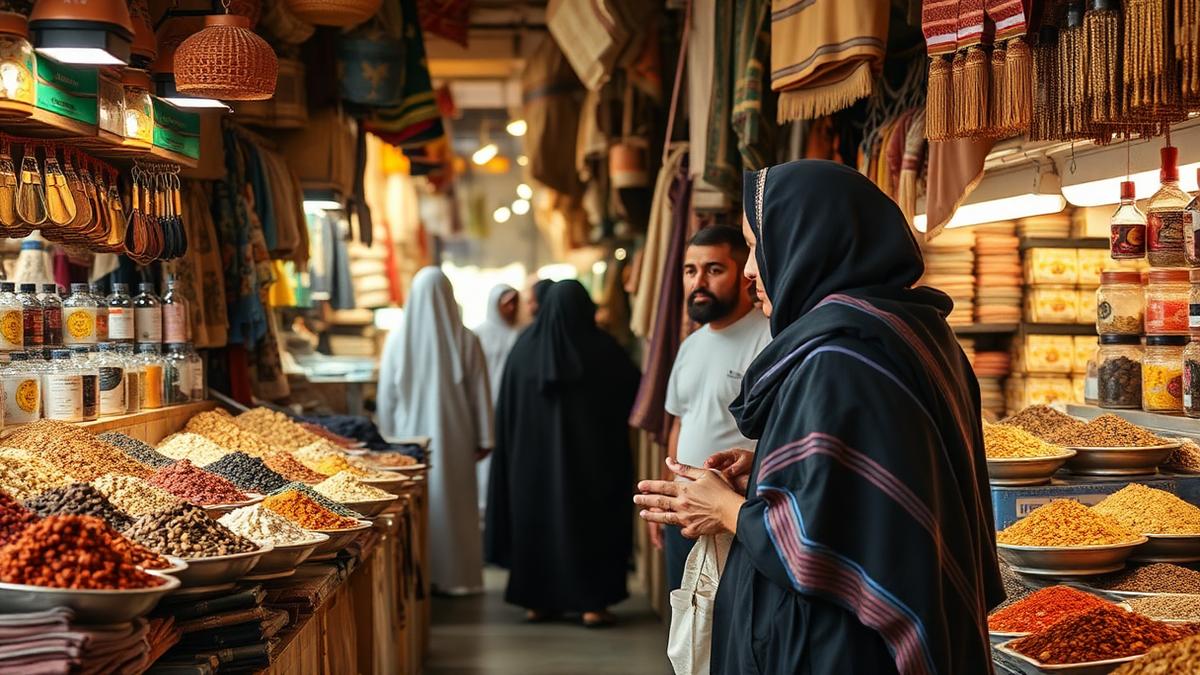
Learning Gulf Arabic with ArabiyaPath
ArabiyaPath is a Gulf-focused Arabic learning platform. Its Gulf Arabic material includes:
- Native Khaleeji audio on vocabulary and phrases.
- Conversation-oriented topics: greetings, transport, restaurants, shopping, work, and social situations.
- A structured path organised by dialect, level, unit, and lesson.
- English translation and transliteration on every card, so no prior Arabic is required.
- Cultural notes where usage differs between Gulf countries.
- Certificates on level completion.
You can try a free lesson before choosing a plan.
Who the course is for
- People living in or moving to Saudi Arabia, the UAE, Kuwait, Qatar, Bahrain, or Oman.
- Professionals working with Gulf colleagues, clients, or partners.
- Travellers who want to handle everyday situations in Arabic.
- Heritage learners who understand some Arabic but have not studied speaking.
- Fusha learners who want to add a spoken variety.
FAQ
What is Gulf Arabic?
Gulf Arabic (Khaleeji) is a group of closely related spoken Arabic varieties used across the Arabian Peninsula. It is used mainly in conversation rather than in formal writing.
Is Gulf Arabic the same as Khaleeji?
Yes. Khaleeji is the Arabic term for Gulf Arabic; the two names refer to the same group of varieties.
Is Gulf Arabic the same as Fusha?
No. Fusha (Modern Standard Arabic) is the shared formal and written variety, while Gulf Arabic is a spoken regional form. They share a great deal of vocabulary but differ in grammar, pronunciation, and use.
Which countries speak Gulf Arabic?
Gulf Arabic varieties are spoken mainly in Saudi Arabia, the United Arab Emirates, Kuwait, Qatar, Bahrain, and Oman, with variation between and within these countries.
Should I learn Fusha or Gulf Arabic first?
It depends on your goal. Choose Fusha for reading, media, and formal or academic use; choose Gulf Arabic if your priority is speaking and understanding everyday conversation in the Gulf. Many learners study both over time.
Can beginners learn Gulf Arabic?
Yes. Beginners can start directly with a spoken variety by focusing on listening, pronunciation, greetings, and high-frequency phrases, adding reading and writing later if needed.
How long does it take to learn Gulf Arabic?
There is no single answer. Time to a comfortable conversational level varies with study time, prior language experience, and how much you speak with others; regular daily practice is the strongest factor.
Can I use Gulf Arabic across all Gulf countries?
Largely, yes. The varieties are closely related and speakers usually understand each other, though some regional forms and vocabulary differ and may need adjustment.
Related reading
- Why Learn Gulf Arabic
- Gulf Arabic vs Fusha Arabic
- 100 Essential Gulf Arabic Phrases
- How to Learn Arabic: A Practical Guide for Beginners
- Arabic for Expats in Saudi Arabia
- Is Gulf Arabic Hard to Learn?
- Gulf Arabic for Business
Start learning today
- 🎁 Try a free lesson — no payment required.
- 📚 Explore the Gulf Arabic course — beginner to advanced, native audio, certificates.
- 🌍 Browse all Arabic dialects and pick the one that matches your goals.