Arabic for Expats in UAE & Saudi Arabia | Essential Life Skills Guide
Reading time: ~8 minutes · Level: Complete beginner · Dialect: Gulf Arabic (Khaleeji)
Expat Summary: English is enough to survive in the Gulf, but not enough to belong. Mastering a core set of Gulf Arabic (Khaleeji) phrases for greetings, prices, and daily communication changes how you are perceived by locals within weeks. For most expats, learning Khaleeji is more practical than Modern Standard Arabic (MSA / Fusha) for daily life in the UAE or Saudi Arabia.
Essential Hubs for Expats
- Daily Survival: 100 Essential Gulf Arabic Phrases
- Professional Life: Gulf Arabic for Business
- Medical Careers: Gulf Arabic for Medical Professionals
- Personalized Growth: 1-to-1 Arabic Tutors
What you'll learn
- The expat's invisible wall
- Why Arabic gives expats an edge
- Fusha vs. Khaleeji: which to learn
- The essential daily-life toolkit
- Cultural rules behind the words
- FAQ for expats
1. The Expat's Invisible Wall
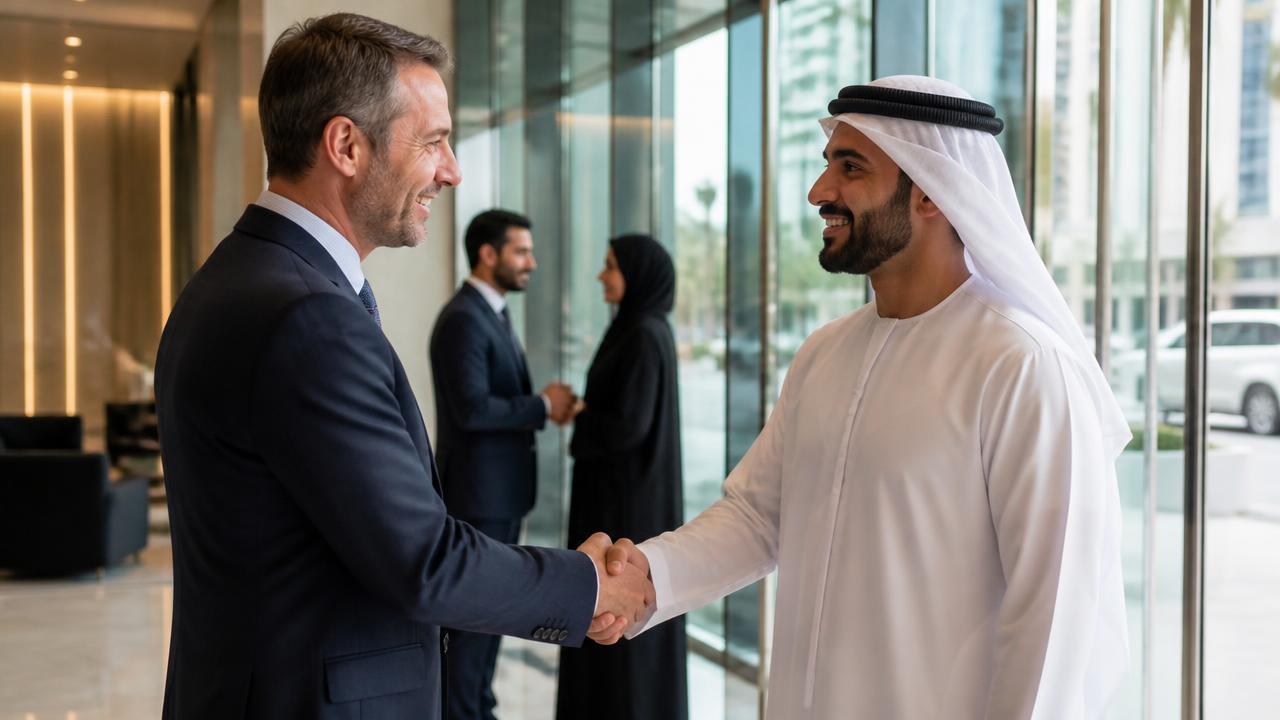
Moving to a global hub like Dubai, Abu Dhabi, or Riyadh is exhilarating. Futuristic architecture, world-class dining, a hundred nationalities in one office building. English is the lingua franca here — you can live comfortably for years without a single word of Arabic.
And yet most expats eventually hit the invisible wall: the barrier that keeps you a permanent visitor instead of a resident. You live in the city without ever being of it.
Arabic is what dissolves that wall. The moment you can go beyond "hello" with a colleague, a neighbour, or the shopkeeper at the souq, the Gulf opens up — the humour, the warmth, and the depth that sit just behind the glass towers. Mastering a few essential Khaleeji phrases is the first step toward that connection.
🎁 Start now: Try your first free Gulf Arabic lesson — no payment, no commitment.
This YouTube Short demonstrates a simple, natural conversation that perfectly encapsulates the daily interactions expats face. Seeing these phrases used in context, with the natural rhythm of Saudi Gulf Arabic, is immensely useful for bridging the gap between textbook learning and real-world fluency.
2. Why Arabic Gives Expats an Edge
| Category | What changes for you |
|---|---|
| Cultural respect | Signals that you value local heritage — interactions become noticeably warmer. |
| Social connection | Takes you out of the expat bubble and into real friendships. |
| Professional edge | Builds trust and rapport in business, especially in majlis culture. |
| Practical ease | Government offices, local markets, and small towns where English thins out. |
In the Gulf, relationships come before transactions — a deal, an invitation, or a favour follows trust, not the other way around. This is especially true in professional settings; see our guide on Gulf Arabic for business or Gulf Arabic for medical professionals for sector-specific etiquette.
As the Arabic saying goes: "A person's language is their identity." Speaking it says you're invested in the region, and that investment pays back. For those seeking faster progress, working with 1-to-1 Arabic tutors can accelerate your integration significantly.
3. Fusha vs. Khaleeji: Which One Should You Learn?
Most schools and apps teach Modern Standard Arabic (Fusha). Fusha is essential for news, formal writing, and literature — but it is not what you hear in a Dubai mall or a Riyadh coffee shop.
For expats, the practical answer is Gulf Arabic (Khaleeji): the spoken dialect of the Arabian Peninsula — the language of the street, the home, and the marketplace.
| Situation | Fusha | Khaleeji | Why Khaleeji wins |
|---|---|---|---|
| Greeting | Kayfa haluka? | Shlonak? | The warm, default greeting across the UAE and Qatar. |
| Ordering | Uridu qahwa. | Aba gahwa. | Aba = "I want" in real speech; you instantly sound local. |
| Asking price | Kam thamanu hadha? | Be-kam? | Shorter, faster, and far more natural in a busy market. |
Choosing Khaleeji avoids the "Fusha trap" — months spent on a formal register that sounds stiff in casual settings. ArabiyaPath's Gulf Arabic course teaches Khaleeji from day one, so every word you learn is a word you can use today.
4. The Essential Expat Toolkit
A. Greetings and social etiquette
Never open with a request. Greet first — always.
| Phrase | Meaning | When to use |
|---|---|---|
| Salam Alaikum | Peace be upon you | The universal opener |
| Wa Alaikum Assalam | And upon you be peace | The expected reply |
| Shlonak? / Shlonich? | How are you? (m / f) | Right after the greeting |
| Ya'teek Al-Afia | May God give you strength | Thanking drivers, waiters, staff |
| Insha'Allah | God willing | Any future plan |
| Alhamdulillah | Praise be to God | "Things are good" |
B. Getting around
- Yameen — right
- Yasar — left
- Seda — straight ahead
- Hina — here
- Waggif hina — stop here
- Kam al-hisab? — how much is the fare?
C. Shopping and bargaining
Mall prices are fixed; in the souq your Arabic earns you money.
- Kam hadha? — how much is this?
- Ghali wayed — very expensive (wayed is pure Khaleeji and always gets a smile)
- Ateeni akhar sa'ar — give me your best price
- Khallas — done / enough (the most versatile word in the Gulf)
D. Coffee and dining
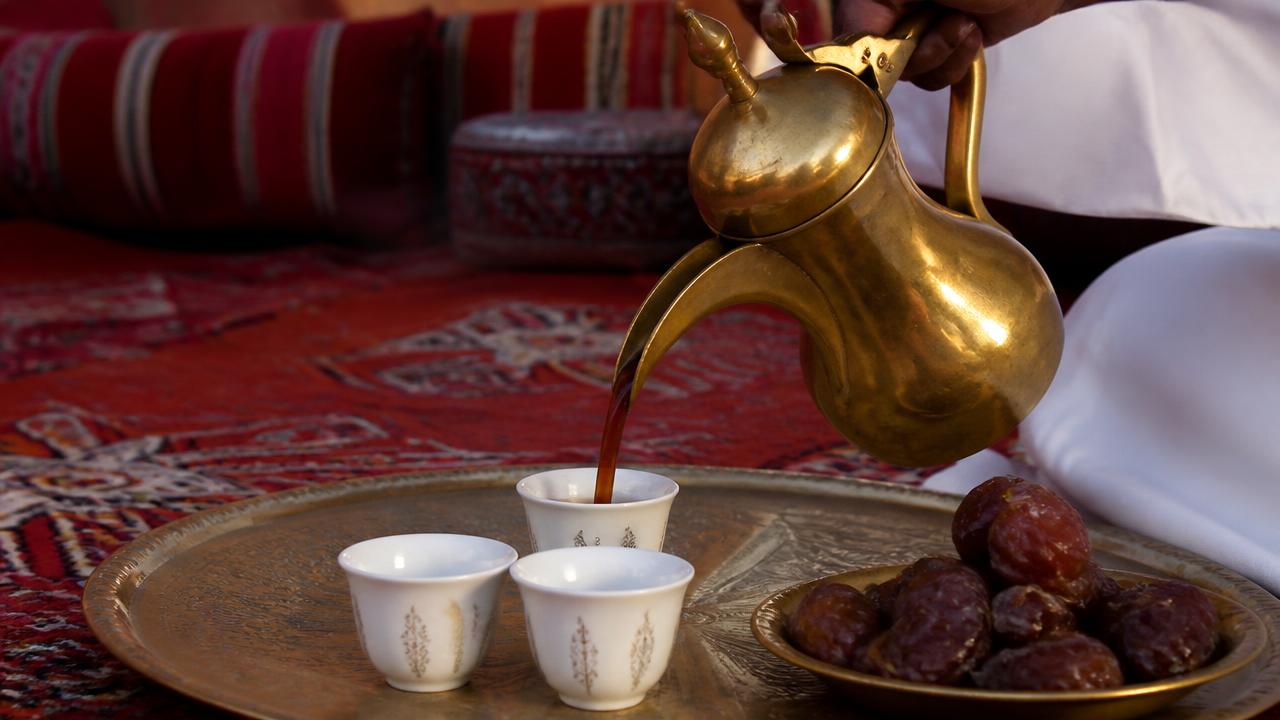
Coffee (gahwa) is the heart of Gulf hospitality.
- Aba… — I want…
- Shukran — thank you
- Afwan — you're welcome / excuse me
- Al-hisab law samaht — the bill, please
- Gahwa — coffee (Gulf speakers turn "q" into "g")
Master these and hundreds more in the full Gulf Arabic course.
5. Cultural Rules Behind the Words
Wasta — the power of relationships. Wasta means influence built through connections. It isn't inherently negative; it reflects the strength of your network. Arabic is the fastest route to building it.
Karam — hospitality. If you're offered coffee or dates, accept, even a sip. When you've had enough, shake the small cup (finjan) gently side to side — that's the polite "no more."
Faith in daily life. Islam is woven into ordinary conversation. Using Insha'Allah or Masha'Allah (when praising something) shows you understand the local worldview, whatever your own beliefs.
6. How to Learn With a Busy Schedule

| Habit | How to apply it |
|---|---|
| The 15-minute rule | Consistency beats intensity — one focused block a day is enough. |
| Use your commute | Native audio while driving or on the Metro turns dead time into practice. |
| Create language moments | One new phrase every time you buy groceries or order coffee. |
| Engage with locals | People are delighted when an expat tries — and will correct you kindly. |
7. Why ArabiyaPath Fits Expats
- Khaleeji-first — the dialect actually spoken in the UAE, Saudi Arabia, and Qatar.
- Native audio — real rhythm and accent, never robotic voices.
- Scenario-based lessons — built around the situations you face weekly.
- Mobile optimized — a full lesson fits into a lunch break.
See the pricing plans and start this week.
8. FAQ for Expats in the Gulf
Is the Arabic script hard to learn?
It looks intimidating, but there are only 28 letters and most students read the basics within a few weeks. ArabiyaPath includes transliteration, so you can speak from day one and pick up the script at your own pace.
Will people laugh at my accent?
The opposite. Gulf locals are famously encouraging and will often switch to slower Arabic to help you along.
Do I need to learn Fusha first?
No. For daily life in the Gulf, starting with Khaleeji is far more efficient. Add Fusha later for news, literature, and formal writing.
How long until I can hold a basic conversation?
With 15 focused minutes a day, most learners manage simple everyday exchanges — greetings, taxis, shopping, ordering — within about 8 to 12 weeks.
Conclusion: Take the First Step
Living in the Gulf is a distinct chapter of your life. A little Arabic turns you from spectator into participant. Learn one phrase today, use it tomorrow — and the invisible wall starts to crumble.
Start your free Gulf Arabic lesson now on ArabiyaPath